
Plitvice Lakes National Park is one of the most photographed natural wonders in Europe. With sixteen interconnected lakes cascading through a limestone canyon, hundreds of waterfalls tumbling over moss-covered tufa barriers, and dense beechwood forests framing every scene, this UNESCO World Heritage Site offers landscape photographers a seemingly endless canvas of turquoise water, dramatic cliffs, and ethereal mist. Located roughly halfway between Zagreb and the Adriatic coast, the park draws over a million visitors each year – which means that timing, planning, and a bit of insider knowledge can make the difference between a snapshot and a portfolio-worthy image.
Whether you are visiting Croatia for the first time or returning specifically for its waterfalls, this guide covers everything you need to know to photograph Plitvice Lakes at its absolute best.
Best Time to Visit for Photography
Every season transforms Plitvice into a different world, but not all seasons are created equal when it comes to photography. The ideal window depends on what kind of images you are after.
Autumn (Mid-September to Late October)
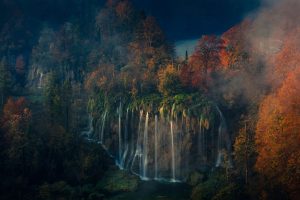
For most landscape photographers, autumn is the undisputed highlight. The beech and maple forests surrounding the lakes erupt in shades of gold, amber, and crimson, and the reflections on the still, turquoise water create compositions that almost look painted. Peak foliage typically occurs between October 10 and 20, though the exact timing shifts from year to year. Early mornings in autumn often bring mist and fog that settle into the canyon, adding a dreamlike quality to long-exposure shots. The days are shorter, which means the park opens close to sunrise and golden-hour light is easier to catch without an extremely early alarm. Visitor numbers are lower than in summer, so you can set up a tripod on the boardwalks without constant foot traffic shaking your frame.
Spring (May to Early June)
Spring is when Plitvice feels most alive. Snowmelt and spring rains swell the waterfalls to their fullest, and fresh green vegetation covers every surface. Wild garlic blossoms carpet the forest floor beneath the beeches, offering excellent macro photography opportunities alongside the grand landscape views. Water levels are high, meaning even secondary cascades that might dry up later in the year are flowing strongly. If you enjoy lush, vibrant greens and powerful water features, late May is the sweet spot.
Winter (December to February)
Winter at Plitvice is a gamble that can pay off spectacularly. When temperatures drop below freezing, the waterfalls partially freeze into curtains of ice, and snow blankets the surrounding forest. Visitor numbers plummet, giving you the park almost entirely to yourself. The challenge is unpredictability – heavy snowfall may close upper-lake trails, and there is no way to predict ice formations far in advance. If you are flexible and can visit on short notice when conditions align, winter photography at Plitvice can yield truly unique images.
Summer (July to August)
Summer is the peak tourist season with daily visitor numbers exceeding 10,000, and it is the least recommended period for serious photography. Water levels are at their lowest, some smaller waterfalls may dry up completely, and the midday light is harsh. If you must visit in summer, arrive before the 7 AM opening and focus your shooting before 9 AM, when the boardwalks are still relatively empty and the light is soft. Overcast or rainy days in summer can actually work to your advantage – clouds create even lighting for long exposures, and rain drives away casual visitors.
The Best Photography Locations
Plitvice covers nearly 300 square kilometres, but the photographic highlights are concentrated along the series of sixteen lakes and their connecting waterfalls. The park is divided into the Upper Lakes (accessed from Entrance 2 near Hotel Jezero) and the Lower Lakes (accessed from Entrance 1 at Rastovača). Each section has a distinct character.
Entrance 1 Viewpoint – The Classic Postcard Shot
The viewing platform at Entrance 1 is where many photographers get their first – and often most iconic – shot. From here, you look down into the Lower Lakes canyon with Veliki Slap (the Big Waterfall) and the Sastavci cascades in full view, framed by lush vegetation. This is the image that appears in almost every Croatian tourism brochure. Arrive at park opening to capture it without dozens of other visitors in the frame. A wide-angle lens in the 16–35mm range works best for this sweeping composition.
Veliki Slap (The Big Waterfall)
At 78 metres, Veliki Slap is the tallest waterfall in the park and one of the highest in Croatia. Interestingly, the waterfall is not fed by the Plitvice Lakes themselves but by the separate Plitvice stream, which crashes over a rock face into the canyon below. You can photograph it from the base of the falls, where the mist and spray create a dramatic atmosphere, or from the elevated viewpoints above. To reach the famous panoramic viewpoint, pass the waterfall, take the stepped path up to the left, follow the road to the right for about 200 metres, and look for the trail to the overlook. From here, you can see the entire lower canyon with its cascading waterfalls and winding boardwalks – a composition that rewards telephoto lenses in the 70–200mm range as well as wider perspectives.
The S-Trail Boardwalk (Lower Lakes)
The S-shaped boardwalk that crosses Kaludjerovac Lake is one of the park’s most recognisable features. Photographed from above, the wooden walkway curves gracefully through crystal-clear turquoise water with the Great Cascades (Velike Kaskade) visible beyond. This bird’s-eye perspective is accessible from the trail between Entrance 1 and shuttle bus stop ST1 – look for the viewpoints closest to the canyon edge. The scene is best captured in soft, overcast light or during the first and last hours of the day when the canyon walls do not create harsh shadows on the water.
Between Lake Galovac and Lake Gradinsko (Upper Lakes)
This stretch of the Upper Lakes is a photographer’s playground. Waterfalls, cascades, and streams are packed tightly together, and a long wooden boardwalk winds through the heart of it all, placing you at water level amid the spray and the sound of rushing water. The variety here is remarkable – within a short walk, you can shoot intimate close-ups of water flowing over tufa formations, wide scenes of multi-tiered cascades, and reflections in calm pools. Morning light is particularly beautiful on the upper lakes because the terrain is more open compared to the deeply incised lower canyon. If you take the first boat across Lake Kozjak in autumn, you may arrive to find mist still clinging to the surface.
Lake Kozjak and the Boat Crossing
Kozjak is the largest of the sixteen lakes and the natural dividing line between the upper and lower sections. The electric boat that ferries visitors across the lake offers a unique perspective that is difficult to replicate from shore – open water, forested hills reflected in the surface, and a picnic meadow on the bank that makes for a serene foreground. While the boat ride itself is brief, keep your camera ready. On calm mornings, the reflections on Kozjak can be mirror-perfect.
Forests and Side Trails
Plitvice is not only waterfalls and lakes. The pristine beechwood forests surrounding the water features are exceptional subjects in their own right, especially for photographers who want to escape the boardwalk crowds. Trails leading through the forest reveal mushrooms and fungi on fallen logs (particularly in autumn), wildflowers in spring, and atmospheric scenes of light filtering through the canopy. The less-trafficked high trail above the lower lakes offers elevated views of the canyon, the waterfalls, and the boardwalks far below – a perspective most visitors never see.
Essential Camera Gear and Settings
Plitvice rewards preparation. The right equipment can elevate your results significantly, while the wrong approach – particularly regarding tripod use and filters – can lead to frustration.
Tripod. A sturdy tripod is the single most important accessory for waterfall photography at Plitvice. Long exposures of one to several seconds are essential for achieving that silky, flowing water effect, and handheld shooting simply cannot deliver this. However, be aware that the wooden boardwalks vibrate with foot traffic. Time your exposures for gaps between groups of walkers, and consider a travel tripod with spiked feet for stability on the wood. Tripods are permitted for personal photography; commercial shoots require a separate permit. Be courteous – the boardwalks are narrow, so set up quickly and move aside when others need to pass.
Lenses. A wide-angle zoom (16–35mm or equivalent) is essential for capturing sweeping lakescapes and waterfall panoramas. A telephoto zoom (70–200mm) is equally valuable for isolating individual cascades, compressing layers of waterfalls, and pulling in details from the viewpoints above the canyon. A macro lens is a worthwhile addition for spring and autumn visits when wildflowers, fungi, and intricate tufa formations provide compelling close-up subjects.
Filters. A circular polariser is nearly essential at Plitvice. It reduces reflections on the water surface (revealing the turquoise colour and the submerged tree trunks below), cuts glare on wet rocks and foliage, and enhances colour saturation. A neutral density (ND) filter – a 6-stop or 10-stop – allows you to extend shutter speeds for silky waterfall effects even in bright conditions. On overcast days or early mornings, you may not need an ND filter at all; the low ambient light naturally permits longer exposures at ISO 100 and small apertures.
Camera settings. For classic waterfall shots, start with ISO 100, an aperture of f/8 to f/13 for sharp depth of field, and let the shutter speed fall wherever it needs to – typically between 0.5 and 4 seconds for a pleasing water blur. Use a remote shutter release or the camera’s built-in timer to avoid vibration. Disable image stabilisation when shooting on a tripod, as it can introduce micro-vibrations on stable mounts. Focus manually or lock autofocus before mounting an ND filter, as heavy ND filters can prevent the camera from acquiring focus.
Practical Tips for Photographers
Arrive at opening time. The park opens at 7 AM in summer and 8 AM during the rest of the year. The first two hours offer the best combination of soft light, minimal crowds, and the chance to encounter morning mist. Most tour buses arrive after 10 AM, and by midday the boardwalks can be nearly impassable. Late afternoon, after 4 PM, is the second-best window as visitor numbers drop significantly.
Buy tickets online in advance. Plitvice operates a quota system limiting entries to 500 per hour. During peak season, tickets sell out quickly. Purchase your ticket online before your visit and keep the PDF on your phone for scanning at the entrance. When buying, you must select your preferred entrance (1 or 2), and you cannot enter through the other one.
Plan for at least a full day. While it is possible to rush through the highlights in four hours, a full day of 6–8 hours allows you to photograph both the upper and lower lakes, wait for optimal light at key locations, and explore some of the less-visited side trails. If your schedule allows, staying overnight near the park gives you the luxury of two early-morning sessions.
Embrace overcast weather. Sunny days create extreme contrast in the narrow canyon of the lower lakes, with half the scene in bright light and half in deep shadow. Overcast skies provide the soft, even illumination that waterfall and forest photography demand. Rain can be an ally – it thins the crowds, adds atmosphere, saturates colours, and creates moody mist among the trees. Pack waterproof clothing and a rain cover for your camera gear.
Wear proper footwear. The boardwalks and trails can be slippery, especially when wet. Sturdy hiking boots with good grip are essential, not only for safety but for confidence when carrying camera equipment on uneven terrain. Dress in layers – mornings in the canyon can be surprisingly cool even when the forecast predicts a warm day.
No drones allowed. Plitvice is a strict no-fly zone. Drones are prohibited throughout the park, and signage is posted at every entrance. Do not plan your shot list around aerial perspectives. The elevated viewpoints above the canyon, however, offer stunning bird’s-eye views that serve as an excellent alternative.
Bring food and water. Toilets and basic cafeterias are available near the park entrances and at boat and shuttle stops, but once you head out onto the boardwalks and trails, there are no facilities. Carry water, snacks, and energy bars to keep yourself going through a long shooting day without needing to return to the entrance.
Beyond Plitvice: Exploring Croatia Through the Lens
Plitvice Lakes is often the centrepiece of a Croatian photography itinerary, but the country offers far more for those willing to explore. The Dalmatian coast, the ancient walls of Dubrovnik, the islands of Hvar and Korčula, and the rugged interior of Istria all present distinct visual stories. The challenge for visiting photographers is knowing where to go and when – the difference between a generic tourist snapshot and a striking image often comes down to being in the right place at the right moment with the right light.
This is where a dedicated photography guide makes an enormous difference. Rather than relying on large group tours that follow fixed schedules regardless of light conditions, working with a local photographer who knows the terrain intimately allows you to adapt to weather, chase the best conditions, and access viewpoints that most visitors never discover. For those planning photography trips to Croatia, the combination of Plitvice’s waterfalls, coastal landscapes, and the cultural richness of Croatian towns creates a diverse portfolio in a compact geography. A knowledgeable local guide can schedule each location for optimal light, adjust the itinerary based on real-time weather, and lead small groups to hidden spots that simply do not appear in mainstream travel guides.
Final Thoughts
Plitvice Lakes National Park is one of those rare locations where the reality genuinely matches the hype. The turquoise water, the layered waterfalls, the ancient forests – they are as breathtaking in person as they appear in photographs, and in many ways even more so. With thoughtful timing, the right equipment, and a willingness to wake up early and embrace imperfect weather, you can return home with images that do justice to one of Europe’s most extraordinary natural landscapes.
The key takeaway for any photographer planning a visit is simple: come prepared, come early, and come with patience. The park rewards those who take the time to observe, wait for the right moment, and look beyond the most obvious compositions. Some of the most compelling images from Plitvice are not the sweeping panoramas from the famous viewpoints, but the intimate details – a single leaf caught in a cascade, the texture of tufa under flowing water, or the pattern of mist rising through autumn trees at dawn.